
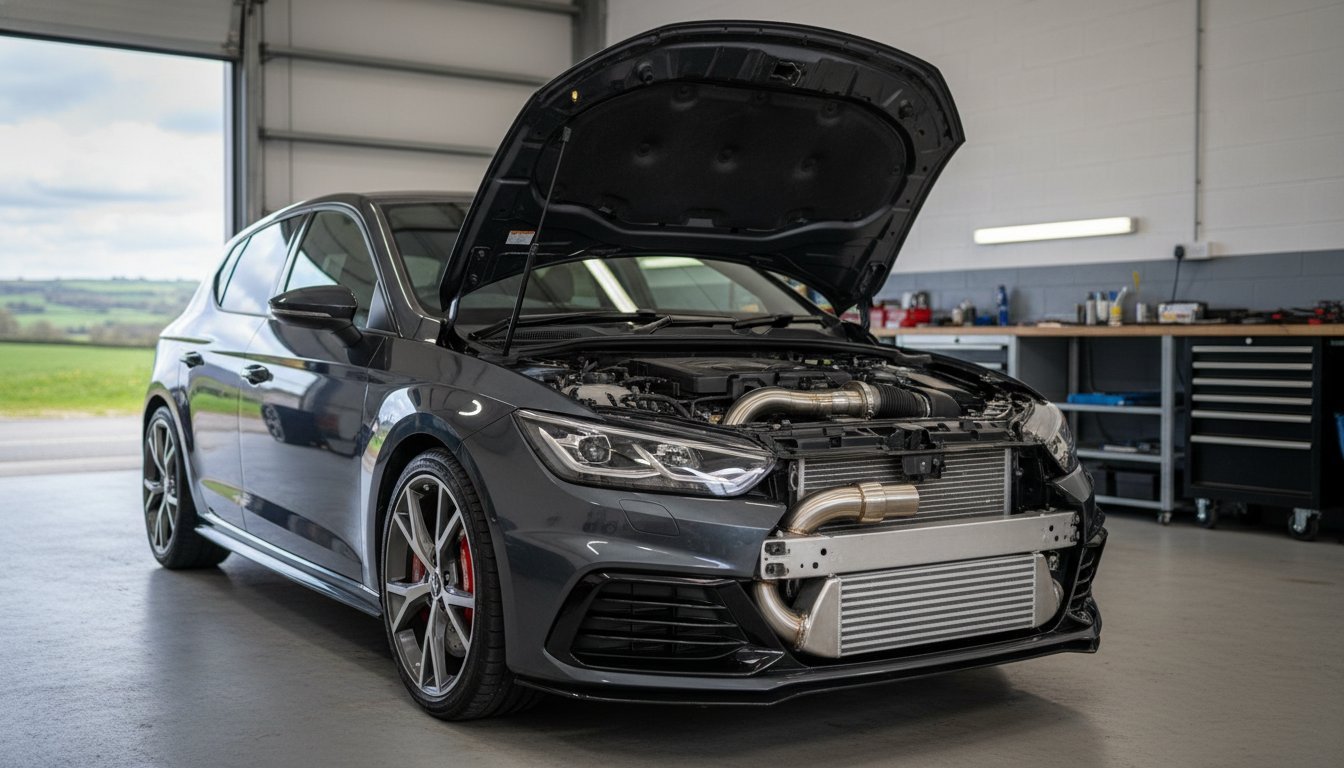
A Stage 2 remap isn’t just a bigger version of Stage 1; it’s a complete recalibration of your vehicle’s performance potential. While software unlocks the power, professional stage 2 tuning shrewsbury requires a precision-engineered synergy between your engine’s ECU and high-flow hardware. You likely want that surge of mid-range torque for effortless overtaking on Shropshire’s A-roads, but the anxiety of clutch slip, turbo failure, or a loud exhaust failing an MOT often stands in the way.
We understand that the jump to Stage 2 can feel like a minefield of conflicting advice. This guide clarifies the confusion by showing you exactly which modifications are essential and which are unnecessary for a reliable build. You’ll discover how to balance performance with longevity, ensuring your vehicle remains a dependable daily driver while delivering exhilarating power. We’ll cover everything from the UK’s 74-decibel noise limit to the hardware investments that can range from £300 to £2,000, giving you a clear roadmap to a safe, software-optimised result.
Key Takeaways
- Learn how stage 2 tuning shrewsbury overcomes factory hardware bottlenecks to deliver superior torque for Shropshire’s demanding A-roads.
- Identify the essential hardware modifications, such as upgraded intercoolers and high-flow downpipes, required to safely support increased boost levels.
- Compare the driving dynamics of Stage 1 versus Stage 2 to determine which power delivery style best suits your daily commute and overtaking needs.
- Master the rigorous maintenance schedule, including specific oil change intervals and spark plug heat ranges, needed to ensure your high-performance build remains reliable.
- Discover why professional data logging and local calibration are vital for protecting your engine from the risks associated with generic, off-the-shelf software.
The Evolution of Power: Defining Stage 2 Tuning in Shrewsbury
Stage 2 represents a fundamental shift in how we approach vehicle performance. Whilst a Stage 1 remap focuses on unlocking the latent potential hidden within factory safety margins, stage 2 tuning shrewsbury is the point where we address physical limitations. Your car’s manufacturer designed the intake and exhaust systems for cost efficiency and noise suppression, not peak flow. When these components become a bottleneck, software alone cannot push further without risking engine health. This process, often referred to as Chip tuning at its most basic level, evolves here into a comprehensive mechanical and digital synergy. It’s no longer just about optimising settings; it’s about re-engineering how the car breathes.
Why Stage 1 is No Longer Enough
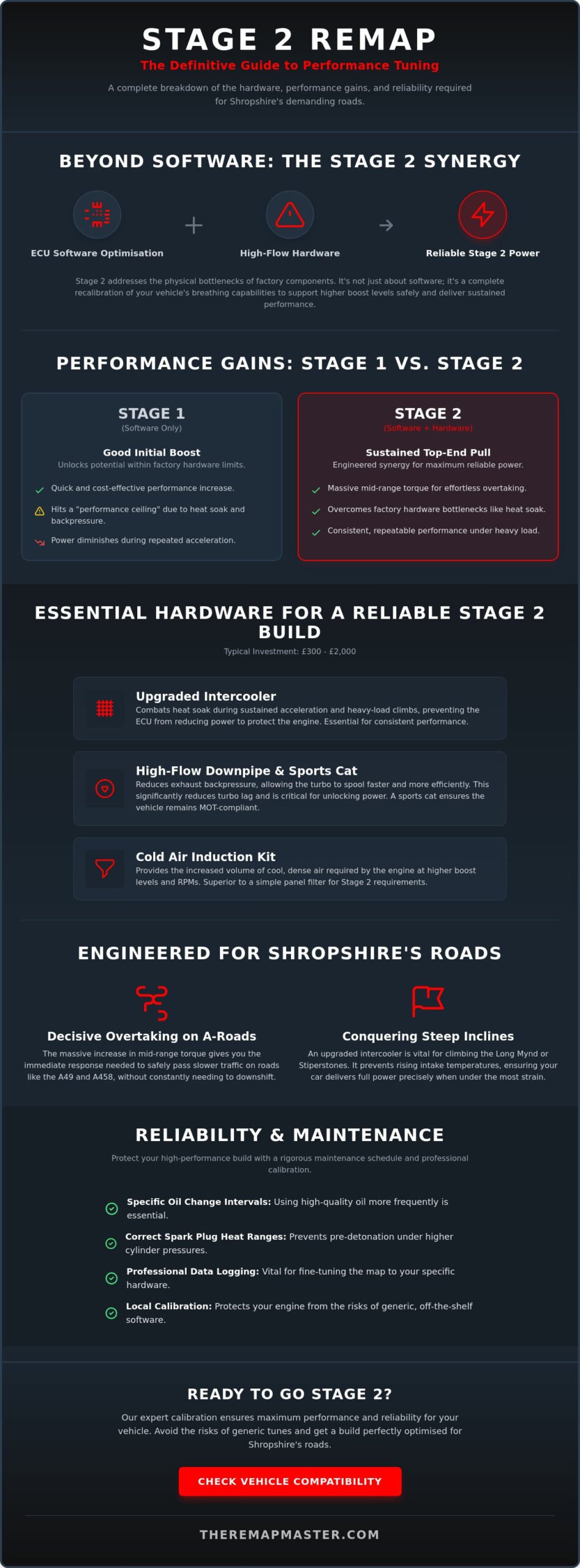
Many drivers start with a Stage 1 remap and enjoy the initial boost, but they eventually hit a performance ceiling caused by heat soak and exhaust backpressure. Standard catalytic converters and intercoolers aren’t built to handle the sustained thermal loads of higher boost pressures. You’ll notice this when the car feels punchy for one pull but loses vigour during repeated acceleration. Adding more boost via software at this point provides diminishing returns. You need to improve the engine’s ability to breathe and stay cool before the ECU can safely command more power. Stage 2 is the definitive solution for drivers who want sustained top-end pull rather than a brief burst of speed.
Shropshire’s Driving Landscape and Stage 2 Benefits
Shrewsbury’s unique geography demands more than just peak horsepower. If you’re frequently using the A49 or the A458, you know the importance of short, decisive overtaking windows. A Stage 2 build prioritises mid-range torque, giving you the immediate response needed to pass slower traffic safely without constantly downshifting. The increased “area under the curve” means your car pulls harder, for longer, through every gear.
The Shropshire Hills present another specific challenge for tuned vehicles. Climbing the steep inclines of the Long Mynd or the Stiperstones puts immense strain on a modified engine. A proper Stage 2 setup includes an upgraded intercooler to combat the rising intake temperatures that occur during these heavy-load climbs. This ensures your car doesn’t pull back timing or reduce power precisely when you need it most. We calibrate the software to ensure the vehicle remains civilised and fuel-efficient in Shrewsbury town centre, whilst transforming into a high-performance machine the moment you hit the open road. It’s a bespoke approach that respects the limits of your hardware whilst maximising its output.
Essential Hardware: What Your Vehicle Needs Before a Stage 2 Remap
To achieve the power levels promised by stage 2 tuning shrewsbury, your vehicle must move more air and fuel than factory components allow. Software can command more boost, but without the Essential Hardware to support it, you risk mechanical stress and safety-mode interventions. The primary goal is to lower Exhaust Gas Temperatures (EGTs) and intake temperatures, creating a stable environment for high-performance calibration. If you aren’t sure if your current setup is ready, you can check your vehicle’s compatibility with our specialist team.
Breathing In: Induction and Cooling Upgrades
Standard air boxes are designed for silence, not volume. For Stage 2, a full cold air induction kit is often superior to a simple panel filter because it provides the massive airflow required at high RPM. However, the real hero is the intercooler. During Shropshire’s warmer months, factory intercoolers quickly succumb to heat soak. This leads to ‘Charge Air’ temperatures rising so high that the ECU pulls back timing to protect the engine, resulting in a noticeable loss of power. We trust brands like Airtec and Wagner for Shropshire builds because they maintain consistent performance even under heavy load.
Breathing Out: Exhaust and Turbo Manifold Dynamics
The biggest physical restriction on a modern turbocharged car is the downpipe. A high-flow downpipe reduces backpressure, allowing the turbo to spool faster and significantly reducing turbo lag. Whilst a decat offers the most flow, it is illegal for road-going vehicles in the UK. A high-quality sports cat provides a legal alternative that still delivers the necessary flow for Stage 2 power gains whilst keeping you within the 74-decibel noise limit. A Stage 2 remap without an upgraded downpipe risks turbocharger over-speeding and premature failure.
Managing fuel delivery is the final piece of the puzzle. On many VAG or BMW platforms, the stock high-pressure fuel pump (HPFP) or injectors may reach their limit at Stage 2 levels. If the fuel system cannot keep up with the increased air volume, the engine will run lean, which is a recipe for catastrophic piston failure. Ensuring your hardware is up to the task before booking your stage 2 tuning shrewsbury session is the only way to guarantee a reliable, high-torque result that lasts.
Stage 1 vs Stage 2: Comparing Performance Gains and Driving Dynamics
Choosing between Stage 1 and Stage 2 is about more than just chasing a higher peak horsepower figure. A Stage 1 remap provides a significant initial “punch” by optimising factory software, but it often tapers off as the stock hardware struggles to dissipate heat. In contrast, stage 2 tuning shrewsbury delivers a sustained, linear pull that continues all the way to the redline. By removing physical restrictions in the intake and exhaust, the engine breathes more freely, making the power delivery feel more like a larger naturally aspirated engine rather than a small turbocharged one under strain.
Peak figures rarely tell the whole story for daily driving. The “area under the curve” is what truly matters for Shrewsbury commuters. This refers to the total amount of power available across the entire rev range, not just at one specific point. A Stage 2 build offers a much broader power band. You will notice this when cruising at motorway speeds; the car feels more effortless and requires fewer downshifts to maintain momentum. Interestingly, fuel economy often improves during steady-state cruising because the engine operates more efficiently with less backpressure. However, when you’re under heavy load, the increased air volume requires more fuel, making the car thirstier during spirited driving.
The Torque Factor: Overtaking on Shropshire A-Roads
The real-world benefit of Stage 2 is most apparent in 30-70mph acceleration times. This is the critical window for safely overtaking on the A49 or A5. Whilst Stage 1 gives you a boost, Stage 2 provides the relentless torque necessary to complete manoeuvres with absolute confidence. To keep this power reliable, our calibration specifically manages torque delivery to protect your transmission. Whether you have a manual clutch or a DSG system, we ensure the torque curve doesn’t spike aggressively enough to cause mechanical slip. When vetting a provider for these services, we recommend reading our guide on choosing a remapping company to ensure they prioritise these safety protocols.
Refinement vs Raw Power
Hardware modifications inevitably change your car’s acoustic signature. An upgraded intake adds a purposeful growl, whilst a high-flow downpipe provides a deeper, more resonant exhaust note. Despite the increase in raw power, a well-calibrated Stage 2 build is never “twitchy” in stop-start traffic around Shrewsbury town centre. The throttle response remains predictable and smooth. To achieve the best results on automatic vehicles, we often suggest a Gearbox Remap (TCU). This ensures the shift points and clamping pressures perfectly complement the new engine output, creating a seamless driving experience that feels factory-refined but significantly more capable.
Reliability and Maintenance: Keeping Your Stage 2 Build Road-Legal
Owning a high-performance vehicle in Shropshire is an exhilarating experience, but it requires a shift in your maintenance mindset. Standard manufacturer service intervals are designed for stock power levels and conservative driving. When you invest in stage 2 tuning shrewsbury, you are operating much closer to the engine’s physical limits. This means a proactive “Stage 2 Service Schedule” is your best insurance policy against mechanical fatigue. If you want to ensure your car remains in peak condition, book a professional health check with our specialist team.
Forget the traditional 10,000-mile oil change. For a Stage 2 build, you should aim for fresh, high-quality synthetic oil every 5,000 to 7,000 miles. Petrol engines also require specific attention to spark plugs. We often recommend moving to a “cooler” heat range plug. These are designed to dissipate heat from the combustion chamber more effectively, which prevents the dangerous pre-ignition that can occur under increased boost pressures. Similarly, keep a close eye on your clutch. If you notice the revs rising faster than your road speed in higher gears, it’s a sign of clutch slip. Upgrading to a reinforced Sachs or LUK kit is often the definitive fix for handling the extra torque.
The Maintenance Checklist for Tuned Vehicles
Your car now possesses significantly more “going power,” so your “stopping power” must keep pace. Upgrading to high-performance brake pads or braided lines is a sensible move to manage the extra kinetic energy. Traction is another critical factor. Shropshire’s country lanes are notoriously greasy, especially during the autumn months. Standard budget tyres will struggle to deploy Stage 2 torque without constant intervention from the traction control system. Premium rubber like Michelin Pilot Sports or Continental SportContacts ensures that the power actually reaches the tarmac safely.
Staying on the Right Side of the Law
Navigating MOT compliance in 2026 requires a transparent approach to modifications. UK law is clear: removing emissions control systems like catalytic converters or DPFs is illegal for road-going vehicles. For visual MOT inspections, the physical structures of these components must remain intact. If your vehicle is intended strictly for off-road or track-use scenarios, we provide a specialised DPF and EGR delete package.
Noise regulations are equally strict, with a 74-decibel limit currently in place. A well-designed Stage 2 exhaust should provide a deeper tone without becoming an anti-social nuisance. Finally, always declare your hardware changes to your insurance company. Many Shropshire drivers fear a premium hike, but failing to disclose a Stage 2 remap or an upgraded intercooler can void your policy entirely. Honesty is the only way to ensure you are fully protected whilst enjoying your stage 2 tuning shrewsbury build.
Professional Stage 2 Calibration: Why Local Expertise Matters
A Stage 2 build is only as good as the software controlling it. Whilst generic, “off-the-shelf” files are common in the industry, they often fail to account for the unique variations in your vehicle’s hardware. One car might have a highly efficient Wagner intercooler whilst another uses a smaller alternative; a generic map treats them the same, often leaving power on the table or pushing components too hard. Professional stage 2 tuning shrewsbury begins with a comprehensive diagnostic health check. We verify that your injectors, turbocharger, and sensors are in perfect working order before we ever attempt to write new software to your ECU.
Custom Software vs Generic Files
Generic files frequently chase “hero numbers” to impress on social media, often by over-boosting the turbocharger beyond its efficient operating range. This creates excessive heat and increases the risk of mechanical failure. Our approach focuses on the synergy between your specific modifications and the ECU. We adjust boost targets, ignition timing, and fuel scaling based on the actual data your engine produces. Live Data Logging is the process of monitoring engine vitals in real-time to ensure the Stage 2 map is safe under load. This allows us to see exactly how your engine behaves on Shropshire’s roads, ensuring the calibration is stable whether you are climbing steep hills or cruising on the A5.
Our expertise isn’t limited to passenger performance cars. We apply the same rigorous data-driven standards to commercial vehicles, offering specialised HGV remapping for Shrewsbury business owners looking to maximise torque and fuel economy. Whether it is a track-focused hatchback or a heavy-duty tractor, the principle remains the same: precision calibration beats generic software every time.
Booking Your Stage 2 Transformation in Shrewsbury
When you book a Stage 2 session with The Remap Masters, you aren’t just getting a file upload. You are getting a full performance consultation. We take the time to log the vehicle’s performance before and after the remap, providing you with the confidence that the gains are both real and safe. Being local to Shrewsbury means we understand the driving conditions you face daily. We don’t just tune for a flat dyno; we tune for the real-world inclines and overtaking windows found across Shropshire.
Choosing a local specialist also ensures you have ongoing aftercare and support. If you decide to add further hardware down the line, such as a water-meth injection kit or a hybrid turbo, we are here to provide the necessary software revisions. We position ourselves as the primary authority in Shropshire tuning by combining transparent technical advice with definitive performance results. Ready to unlock your car’s true potential? Contact the masters today to start your Stage 2 journey.
Unlock the True Potential of Your Build
Achieving Stage 2 power is a significant milestone for any enthusiast. It represents the perfect balance between mechanical upgrades and digital precision. By moving beyond the limitations of factory hardware, you’ve seen how a custom-calibrated remap provides the sustained torque needed for confident Shropshire overtaking. Remember that longevity depends on a proactive maintenance schedule and the use of high-quality hardware that respects UK road regulations. Stage 2 tuning shrewsbury is not just about peak figures; it’s about creating a refined, high-performance machine that excels on every A-road and motorway journey.
Our team of expert software calibrators is ready to guide you through the process. We perform comprehensive on-site diagnostic health checks to ensure your vehicle is ready for the increase in load. As specialists in Shropshire performance builds, we prioritise safety and reliability alongside raw power. Don’t settle for generic files that risk your engine’s health. Book Your Stage 2 Consultation in Shrewsbury Today and experience the definitive difference of professional calibration. Your vehicle’s ultimate performance is just one session away.
Frequently Asked Questions
Is Stage 2 remapping safe for high-mileage engines?
Stage 2 is safe for high-mileage engines provided the vehicle has a clean bill of health and a solid service history. We always perform a comprehensive diagnostic check to ensure the turbocharger, injectors, and core internals can handle the increased load. If your engine is well-maintained, the transition to stage 2 tuning shrewsbury won’t cause immediate issues, though it may accelerate the wear of older seals or gaskets under higher boost pressures.
Will a Stage 2 remap pass an MOT in the UK?
Your vehicle will pass an MOT as long as the emissions control systems, such as the catalytic converter or DPF, remain physically present and functional. It is illegal to remove these components for road use, and doing so results in an automatic fail. Provided your exhaust setup stays within the legal 74-decibel noise limit and retains its filtration structures, your Stage 2 build remains fully road-legal.
How much extra insurance will I pay for a Stage 2 remap?
Insurance increases vary significantly between providers and depend on your specific vehicle and driving history. You must declare all software and hardware modifications to ensure your policy remains valid in the event of a claim. Some specialist insurers in Shropshire offer competitive rates for modified cars, often providing “like-for-like” cover for your performance parts rather than just the factory value.
Do I need an upgraded clutch for a Stage 2 remap?
You may need an upgraded clutch if the torque output exceeds the factory part’s clamping capacity. Manual cars often experience slip in fourth or fifth gear once Stage 2 torque levels are reached, making a reinforced Sachs or LUK kit a wise investment. For automatic vehicles, we often recommend a TCU remap to increase clamping pressures, which helps the gearbox manage the extra power without physical hardware changes.
What is the typical power gain for Stage 2 vs Stage 1?
Stage 2 offers a more sustained power delivery across the rev range rather than just a higher peak figure. Whilst Stage 1 provides a moderate boost on stock hardware, Stage 2 exploits your high-flow modifications to deliver a broader power band. This results in much more aggressive mid-range torque and a top-end pull that doesn’t taper off, which is ideal for the short overtaking windows found on Shropshire A-roads.
Can I run Stage 2 software on a completely stock car?
You cannot run Stage 2 software on a stock car without risking catastrophic engine or turbocharger failure. The software is specifically calibrated to work with high-flow hardware that reduces backpressure and intake temperatures. Without an upgraded downpipe and intercooler, the ECU will detect excessive heat and pull back power, or worse, cause the turbo to over-speed beyond its design limits.
Does Stage 2 tuning affect my car’s resale value?
Resale value depends entirely on the buyer, but a professionally documented stage 2 tuning shrewsbury build can be a selling point for enthusiasts. Buyers value builds that use reputable hardware brands and have been calibrated by specialists with a clear record of safety. To protect your value, we recommend keeping all your original factory parts so the vehicle can be returned to stock if you choose to sell it through a main dealer.
How long does a Stage 2 remapping process take?
A professional Stage 2 calibration typically takes between two and four hours to complete. This duration allows us to perform a pre-tuning health check, install the custom software, and conduct live data logging to verify engine vitals under load. We don’t rush the process, as real-world testing is essential to ensure the map is perfectly stabilised for your specific hardware configuration.
